What Is The Ordinate Of Influence Line

What Is The Ordinate Of Influence Line For Reaction Rd As Shown In Following figure?

निम्नलिखित चित्र में प्रतिक्रिया RD के लिए बिंदु पर प्रभाव रेखा का ordinate (निर्देशांक ) क्या है ?


This Question Is Related to TOS ( THEORY OF STRUCTURE) topics In short we can say that IN TOS it comes under Influence line Diagram (ILD) Topic
now we have to solve in simplest way
so here is the solution for this questions


From similar triangles BFC and DEC

BF/BC = DE/DC

BF/2 = 1/4

BF=0.5


If you really found your solutions what you wanted than please write a review our team will be always tahnkful to you


Thank You So Much For Visiting Here 
HAVE A NICE DAY

consistency test of cement


Name of experiment:-To determine the percentage of water for normal consistency for a given sample of cement.


Apparatus :-
1)Vicat’s apparatus with plunger of 10mm dia, 
2)measuring cylinder,
3)weighing balance, 
4)weight box, , 
5)trowel.

Theory : 
Standard consistency of cement is defined as that consistency
witch will permit plunger to penetrate at 33.34 from the top of the
mould. The consistency cement paste is expressed as a percentage
by wt of dry cement. Usually this percentage varies from 26% to
33%.


Vicat’s Apparatus : As vicat’s apparatus consist of a frame bearing a movable rod of
weight 300grms. At the upper end of this rod a cap is provided low
rend 1.13mm n of weight 300grms. It the upper end of this rod a
cap is privy deed while at the 1.13mm needle or plunger of 10mm
diameter is shown in figure

Diagram : Vicat’s apparatus, plunger
Vicat's appratus         


Procedure

1.Take 400gm of cement and weight carefully and Add 20% water
in Care should be taken that mining time is not less than 3min and
gauging shall be counted from the time of adding water

2.Fill the paste in the mould .The excess paste to trim off and
vibration are given to remove air bubbles.

3.Fix the 10mm dia. plunger in the moving rod and bring down in
touch with the paste

4.Release the plunger.

5.Repeal the procedure till it penetrate 33-34mm from the top &
note down the water percentage

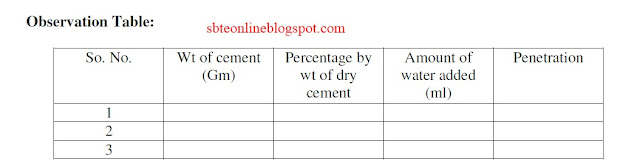
prepare a observation table
 observation table


Precaution
1) The procedure should be conducted within 3-5min
2) The reading should be taken carefully

Result
The percentage of water for normal consistency for the given sample of cement is ……..


This website is created Only For help of our future engineers


thank you 
have a nice day

QUANTITY SURVEYING & COSTING - II syllabus

QUANTITY SURVEYING & COSTING - II


Subject Code
15508
Sessional
No of Period in one session : 50
          No. of Periods Per Week
Full Marks
:
50
L
T
P/S
Annual Exam.
:
30
-
-
4
Internal Exam.
:
20

Rationale:
This is a core technology subject which will enable the students to learn core facts, concepts, principles & procedures in Estimating & Costing. With this knowledge and skill, he will be able to prepare estimate before start of construction and systematically procure materials during execution using specifications for ensuring appropriate type of construction processes & quality of engineering products in specialized areas in Building Construction, Irrigation, Transportation and Environmental Engineering.

Objectives:
Students should be able to:
1)  Decide Approximate Cost of Civil Engineering Structure.
2) Prepare check list of items of construction.
3) Prepare estimate for civil engineering work.
4) Prepare rate analysis of item of construction.
5) Take measurement of completed work.
6) Compare actual quantity with estimated quantity.

Assignments:
Skills to be developed:

Intellectual Skills:
a. List various items of work with their units in a Civil Engineering Structure.
b. Calculate quantities of various items of work.
c. Prepare rate analysis.
List of Sessional Work:
1) Prepare Check list of items of following type of Civil Engineering works.
a) Load Bearing type Building
b) Framed structure type building
c) W.B.M.Road
d) Septic Tank
e) Community well
2) Writing the rules of deduction’s for below mentioned items of work as per IS 1200.
a) Brick / Stone masonry.
b) Plastering / Pointing
3) Taking out quantities of various items of work for load bearing building.
i) Earth work in excavation for foundation
ii) Base Concrete of foundation
iii) U.C.R./BB Masonry work in foundation and plinth.
iv) D.P.C.
v) Plinth Filling.
vi) Brick work in masonry.
vii) Flooring
viii) Plastering.
ix) Wood work in doors & windows
4) Taking out quantities of following items for small R.C.C. Hall
i) Concreting for footing, Column, Beam, slab.
ii) Reinforcement for above items by preparing Schedule of bars.
iii) Form work for all above items.
5) Preparing detailed estimate of a RCC single & two storied residential building for
all items of work. (The quantity of reinforcement shall be calculated by percentage.)
6) Preparing Rate analysis of following items:
Building work – Brick work, P.C.C., R.C.C., Plastering, Flooring, Doors, Windows.
7) Taking out quantities of earth work for a Road profile prepared in surveying subject.
Prepare the lead statement.
8) Taking out quantities of work for a Community well or Jack well or Septic Tank.
9) Taking out quantities of work for pipe culvert.

(Drawings shall be provided for the above exercises by subject teacher.)


1.  Reference Books:

Sl.
No.
Title

Author

Publisher

1.

Estimating & costing in Civil Engineering
B.N. Datta

UBS Publishers Distributors
Pvt Ltd New Delhi
2.

Estimating & costing,
Specification and Valuation in Civil Engineering
M. Chakraborti

M. Chakraborti , Calcutta


3.
Estimating & costing
S.C. Rangwala
Charotar Publication Anand
4.
Civil Engineering Estimating,
Contracts and accounts Vol . I
B.S. Patil

Orient Longman, Mumbai

5.
Estimating & costing
G. S. Birdie
Dhanpat Rai and Sons Delhi

2. Video Cassettes /CDS:

Sl. No.
Title
1.
Q. E. PRO software

3. IS/INTERNATIONAL CODES:


Sl. No.
Title
1.
IS 1200- Method of Measurement of building and Civil engineering works

COMMUNITY DEVELOPMENT AND APPROPRIATE TECHNOLOGY syllabus

COMMUNITY DEVELOPMENT AND APPROPRIATE TECHNOLOGY


Subject Code
16505
Theory
No of Period in one session : 60
No. of Periods Per Week
Full Marks
:
100
L
T
P/S
Annual Exam.
:
80
06
-
-
Internal Exam.
:
20

Rationale and Objective:
India is predominantly an agricultural country with more than 80% of its population living in about 60 lacs village in the country. The spectacular advancement otherwise achieved in science and technology have not been properly harnessed for improving the quality of life of the rural poor. A huge investment in terms of men, material and capital has gone into a variety of rural development programmes, but they have not been able to make any significant change of the formidable problems of rural poverty and unemployment.
The necessity of having technical manpower properly trained in rural technology and management at appropriate levels can not be over emphasized.

S.No.
Topics
Periods
01

Community Development.
(02)
02

Appropriate technological option for rural extension.
(08)
03

Definition & concept of process and product development.
(04)
04

Virgin & Waste land.
(03)
05

Reclaimation programme.
(04)
06

Promotion of improved Agricultural Technique and Land utilization.
(04)
07

Equipment used in Technology transfer.
(04)
08

A Powerful aid to mix farming techniques (Animal Husbandry).
(06)
09

Development of fruit cultivation.
(06)
10

Development of Village handicrafts leading to employment.
(04)
11

Arboriculture development of social forest for fuel wood.
(05)
12

Communication.
(03)
13

Community Health & Hygiene.
(04)
14

Adult Education.
(03)

Total :
(60)

CONTENTS:
TOPIC: 01 – COMMUNITY DEVELOPMENT :
[02]
01.01
Meaning and objective of community development role of technical institution particularly polytechnics and community polytechnics in the field of community development: Objectives.
TOPIC: 02 – APPROPRIATE TECHNOLOGICAL OPTION FOR RURAL EXTENSION:
[08]
02.01
Concept of appropriate technology, appropriate technological options in the fields of farm machinery and post harvest, soil and water conservation irrigation including drip irrigation and rain harvesting, Rural water management community health & hygiene & Rural transport, Rural housing Draught Animal Power, rural industries etc.


TOPIC: 03 – DEFINITION & CONCEPT OF PROCESS AND PRODUCT DEVELOPMENT:
[04]
03.01
Definition & concept of process and product development of community need based items.
03.02
Defining technology transfer concept components of technology invention, innovation and dissemination of information.
TOPIC: 04 – VIRGIN & WASTE LAND:
[03]
04.01
Survey of available virgin and waste lands.
TOPIC: 05 – RECLAIMATION PROGRAMME:
[04]
05.01
Mobilisation of local people on co-operative basis.
05.02
Irrigation facilities to the reclaimed land with the help of existing system or by other method impounded reservoirs which has a dual water pisci-culture.
TOPIC: 06 – PROMOTION OF IMPROVED AGRICULTURAL TECHNIQUE AND LAND UTILIZATION:
[04]
06.01
Reclaimed land utilized for a pilot project on improved land utilization by a varied crop patterns.
06.02
Provision for improved seed farm catering the area.

TOPIC: 07 – EQUIPMENT USED IN TECHNOLOGY TRANSFER:
Various communication option for effecting technological transfer at the grass root level.
[04]

07.01
Mass Communications/motivational approach & techniques.
07.01.01
Mass Media including Radio, T.V., V.C.R.
07.01.02
Print Media including pamphlets, brochures, booklets etc.
07.01.03
Workshop, Seminar Symposium folk dance & drama song role plan, sheet plans contact drive on special occasion.
07.02
Demonstration & Exhibition of technological options to be transferred.

TOPIC: 08 – A POWERFUL AID TO MIX FARMING TECHNIQUES(ANIMAL HUSBANDRY):
[06]
08.01
Concept of mixed farming.
08.02
Rearing of cattle and other domestic animals sheep and goats, piggery etc.
08.03
Direct economic bearing of mixed farming.
08.04
Farm wastes(non marketable positions) used for fodder as well as for composing the residue with animal excreta, Bio gas generation.
TOPIC: 09 – DEVELOPMENT OF FRUIT CULTIVATION.
[06]
09.01
Management of fruit garden.
09.02
Fruit rearing techniques.
09.03
Fruit harvesting and marketing.
09.04
Fruit preservation.
09.05
Fruit canning industry as a cottage industry-employment of women folk.
TOPIC: 10 – DEVELOPMENT OF VILLAGE HANDICRAFTS LEADING TO EMPLOYMENT:
[04]
10.01
Manufacture of mats-baskets.
10.02
Manufacture of bed spreads cotton blankets (stiched old clothes in beautiful pattern like quits).
10.03
Manufacture of papad or other products for urban kitchen made of lentil paste.
10.04
Mixed pickles James, Jellies or the like leading to a guillotine on the distress gole of form products during pick harvesting period.


TOPIC: 11 – ARBORICULTURE DEVELOPMENT OF SOCIAL FOREST FOR FUEL WOOD:
[05]
11.01
Indiscriminate deforestation due to a great dearth of cheep fuel wood.
11.02
Burning animal dung in form of cakes losing its other valuable potential.
11.03
Land hither to be coming out of use due to excessive moisture storage is very suitable for cultivation of deciduous trees which consumes enormous amount of moisture and grow quickly.
11.04
Elements from community septic tank can be discharged on such land solving social problems.

TOPIC: 12 – COMMUNICATION:
[03]
12.01
Improvement and maintenance of existing village roads by adopting new techniques.
12.02
Development of improved animal driven cart for efficiency and preventing damage to rural roads.
TOPIC: 13 – COMMUNITY HEALTH & HYGIENE:
[04]
13.01
Environmental up lift for general improvement of health.
13.02
Hygiene and public health awareness.
13.03
House to house health training for effective motivation.
13.04
Responsibility of schools.
TOPIC: 14 – ADULT EDUCATION:
[03]
14.01
Establishment of night school for adult literacy and education.
14.02
Audio signal programme for effective motivation.

Books Recommended:

1.       
Jaivik Khad, Indian Council of Agricultural Research.
-
A. C. Gard, M. A. Idani and R. P. Abrahim
2.       
Science & Technology for Rural Development, S. Chand & Company Ltd.
-
B. C. Chattopadhyay